

🚀 New Things in SEO: The 2026 Guide Every Marketer Must Read
February 17, 2026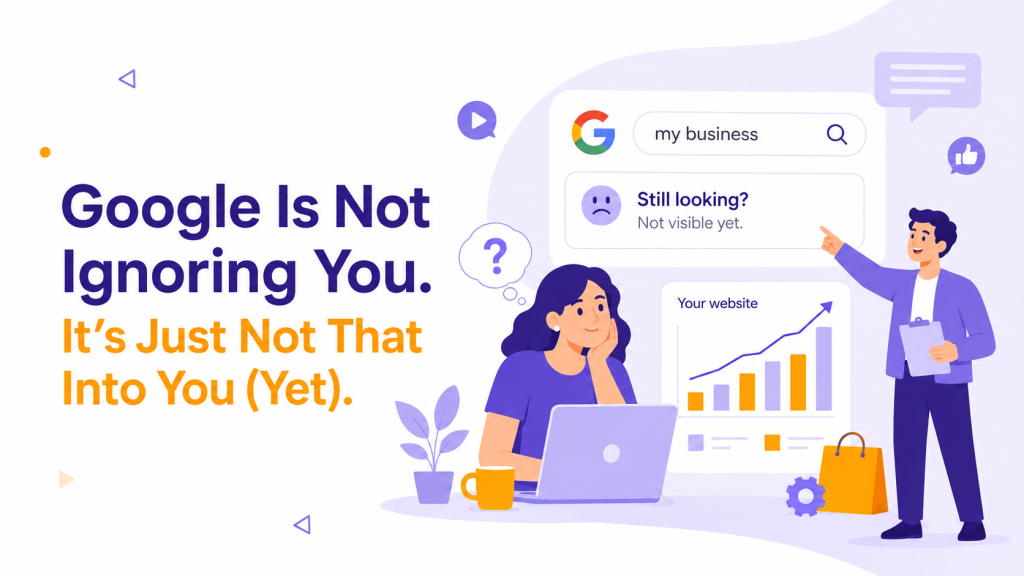
Let’s be honest. We’ve all been there.
You launch a beautiful website. You’ve spent hours choosing the perfect colours, rewriting your homepage headline 17 times, picking images, and making sure every button looks absolutely perfect.
You hit Publish.
And then… nothing.
No visitors. No enquiries. No new customers.
You open Google Search Console. You refresh it. You refresh it again. You even try searching for your business name in an incognito window.
Still nothing.
At this point, you’re starting to wonder whether Google has blocked you personally.
Good news: it probably hasn’t.
Bad news: Google doesn’t owe your website a date.
1. Having a website doesn’t mean people will find it
Imagine opening a beautiful little shop in the middle of nowhere.
The interior is stunning. Your products are amazing. You’ve even got a lovely sign above the door.
There’s just one problem.
Nobody knows the shop exists.
That’s exactly what happens when businesses launch a website without an SEO strategy.
A website is your digital shopfront. SEO is how you help people find the door.
And no, simply adding the words “best company in town” to your homepage won’t magically solve everything.
Google needs to understand:
- What your business actually does.
- Who your products or services are for.
- Where you operate.
- Whether your website provides useful, trustworthy information.
- Why your pages deserve to appear in search results.
Think of SEO as building a relationship with Google. It takes consistency, trust and a little patience.
Unfortunately, there is no Tinder Premium subscription for Google rankings.
2. Stop writing for Google. Start writing for actual humans.
One of my favourite SEO observations is that businesses sometimes create content that sounds like it was written by a robot having a very stressful day.
For example:
“Best digital marketing agency providing professional digital marketing services for businesses looking for digital marketing solutions.”
Congratulations. You’ve used the keyword approximately 47 times.
But would a real person enjoy reading that?
Probably not.
Modern SEO is about understanding what people are looking for and giving them a genuinely useful answer.
Instead of writing another generic article about your services, answer the questions your customers actually ask.
For example:
- How much does professional SEO cost?
- Why isn’t my website appearing on Google?
- How can a small business attract more local customers?
- Is SEO worth investing in if I have a small budget?
Useful content attracts attention because it solves real problems.
And that’s a much better strategy than trying to impress an algorithm with keyword gymnastics.
3. Local SEO: Because your next customer might be just around the corner
Here’s something small businesses often underestimate: local SEO.
You don’t necessarily need thousands of visitors from around the world.
If you run a dental clinic in Craiova, you probably don’t need someone searching for dentists in London.
You need people in Craiova looking for a dentist.
That’s where local SEO becomes incredibly valuable.
A good local SEO strategy includes:
- Optimising your Google Business Profile.
- Keeping your business name, address and phone number consistent.
- Collecting genuine customer reviews.
- Creating useful location-specific website content.
- Making sure your website works perfectly on mobile.
- Building relevant local links and business mentions.
And please, don’t forget your Google Business Profile.
It’s often one of the first things potential customers see when looking for a local business.
Your website might be beautiful, but if your business information is outdated, your opening hours are wrong and your last review is from 2019, we have a little housekeeping to do.
4. SEO is not a magic trick. Sorry.
I wish I could tell you that there’s one secret SEO trick that will put your website at the top of Google overnight.
There isn’t.
Anyone promising guaranteed first-place rankings in seven days should probably be approached with a healthy amount of scepticism.
SEO requires:
- Technical improvements.
- High-quality content.
- Relevant keywords and search intent.
- A good user experience.
- Authority and trust.
- Regular monitoring and optimisation.
And sometimes, it requires fixing things that nobody wants to hear about.
Like the fact that your beautiful website takes eight seconds to load.
Or that five different pages are competing for exactly the same keyword.
Or that your homepage has more animations than useful information.
We love a beautiful website. But we love a website that actually brings customers even more.
5. Your competitors aren’t necessarily better. They might just be easier to find.
This is probably the most frustrating part of online visibility.
You know your business is good. Your customers love your products. Your service is excellent.
Yet your competitor appears above you in Google.
Does that mean they’re better?
Not necessarily.
They might have:
- Better-optimised service pages.
- More relevant content.
- A stronger local presence.
- Better technical SEO.
- More quality backlinks.
- A website that answers customer questions more effectively.
The internet doesn’t automatically reward the best business.
It rewards websites that demonstrate relevance, usefulness and trust.
The good news? These are things you can work on.
6. A little SEO reality check
Before spending money on another website redesign, ask yourself these five questions:
- Can potential customers actually find my website on Google?
- Do my main service pages target the right search intent?
- Is my website fast and mobile-friendly?
- Does my Google Business Profile accurately represent my business?
- Am I measuring enquiries and conversions, or just celebrating website visits?
If you answered “I’m not sure” to most of these questions, that’s a pretty good place to start.
You don’t necessarily need a completely new website.
You might just need a better strategy.
Final thoughts: Give Google a reason to like you
SEO isn’t about tricking Google.
It’s about making your business easier to understand, easier to find and more useful to the people searching for what you offer.
And yes, it takes time.
But when the right people start finding your website, discovering your services and contacting your business, you’ll realise that the effort was worth it.
So, stop refreshing Google Search Console every five minutes.
Take a breath. Check your strategy. Fix the basics. Create something useful.
And remember:
Google isn’t ignoring you. It just needs a few more reasons to recommend you.
Need a little help getting noticed?
At Webdipity, we help businesses improve their online visibility through SEO strategy, technical optimisation, content and local SEO.
Whether you’re starting from scratch or wondering why your existing website isn’t bringing enough enquiries, let’s find out what’s holding it back.
Your next customer is searching. Let’s make sure they can find you.